How Many Weeks Are in a Life?
There is no single number. Compare 80, 85 and 90-year horizons, and learn why 52 weeks is not exactly one calendar year.

There is no single number, because the answer depends on which age you pick: 80 years is about 4,174 weeks, 85 years about 4,435, and 90 years about 4,696. These are unit conversions rather than predictions about anybody in particular.
The number you have probably seen, four thousand weeks, corresponds to roughly 76.7 years and comes from the title of Oliver Burkeman’s book. The other number you have probably seen is 4,680, which is the neat 90-by-52 grid on most life-calendar posters, and it is about sixteen weeks short of ninety actual years.
That gap between the tidy grid and the real arithmetic is the most interesting thing here, and it is explained below.
The common horizons
All of these use the average calendar year of 365.2425 days, which is what you get once leap years and the century rules are folded in. The formula is years times 365.2425 divided by seven.
- 80 years
About 29,219 days, 4,174 weeks, or 960 months.
- 85 years
About 31,046 days, 4,435 weeks, or 1,020 months.
- 90 years
About 32,872 days, 4,696 weeks, or 1,080 months.
- 4,000 weeks
28,000 days, or about 76 years and eight months.
Why the poster and the calculator disagree
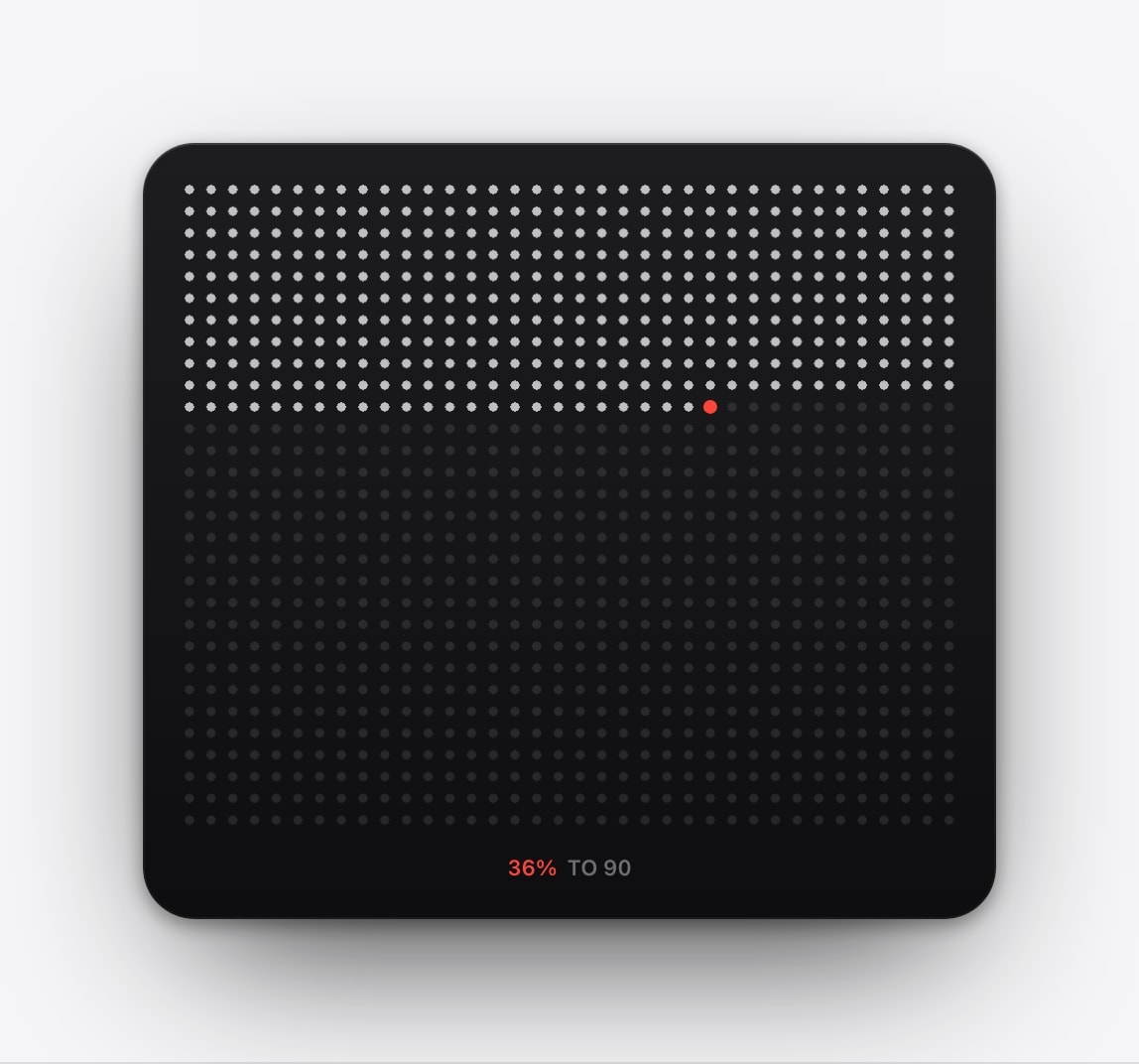
A life-calendar poster almost always draws 52 columns, because everybody thinks of a year as 52 weeks. Fifty-two weeks is 364 days, and a calendar year is 365 days, or 366 in a leap year. So every single year the grid quietly loses somewhere between one and two days.
Over a lifetime that adds up in a way that is easy to underestimate. The average shortfall is 1.2425 days a year, which is about 0.18 of a week, and across ninety years it comes to almost exactly sixteen weeks. That is the entire difference between the poster’s 4,680 cells and the 4,696 weeks that ninety years actually contains: four months of life that fell through the gaps in a drawing convention.
Neither version is wrong as long as it is labelled honestly. The regular grid is a design model, chosen because 52 even columns are legible and 52.18 ragged ones are not. The exact figure is date arithmetic. Calendarly draws the regular grid and calculates your current position from your real birth date, which is the combination that keeps the picture readable and the marker correct.
Which unit is worth using
Weeks are the default for good reason, but they are not automatically the right choice for everybody, and switching unit changes the emotional temperature of the chart considerably.
Fine enough to correspond to something you can remember, coarse enough that decades still fit in one view.
Far fewer marks, much less daily pressure, and easier to think in when the horizon is long.
A horizon is not an expiry date. None of these numbers says anything about an individual. They convert a chosen age into a different unit, and that is the whole of what they do.
The honest answer is a range
Four thousand weeks is memorable. About 4,700 describes a ninety-year horizon more accurately. Neither of them tells you how many weeks you personally have, which is the one number the arithmetic cannot reach.
Questions people ask
About 4,174, using the average calendar year of 365.2425 days.
About 4,696. A neat 90-by-52 poster grid shows 4,680 cells, which is roughly sixteen weeks fewer.
It is a memorable approximation for about 76.7 years, and the title of Oliver Burkeman’s book about finitude.
No. Fifty-two weeks is 364 days, while a calendar year is 365 or 366. The difference is why the tidy grid falls short over a lifetime.
No. It converts a chosen age into another unit and nothing more.